01
Pilot one class
Start with a single teacher, a known group of students, and private project creation while staff learns the workflow.
Access stays narrow and projects begin private.
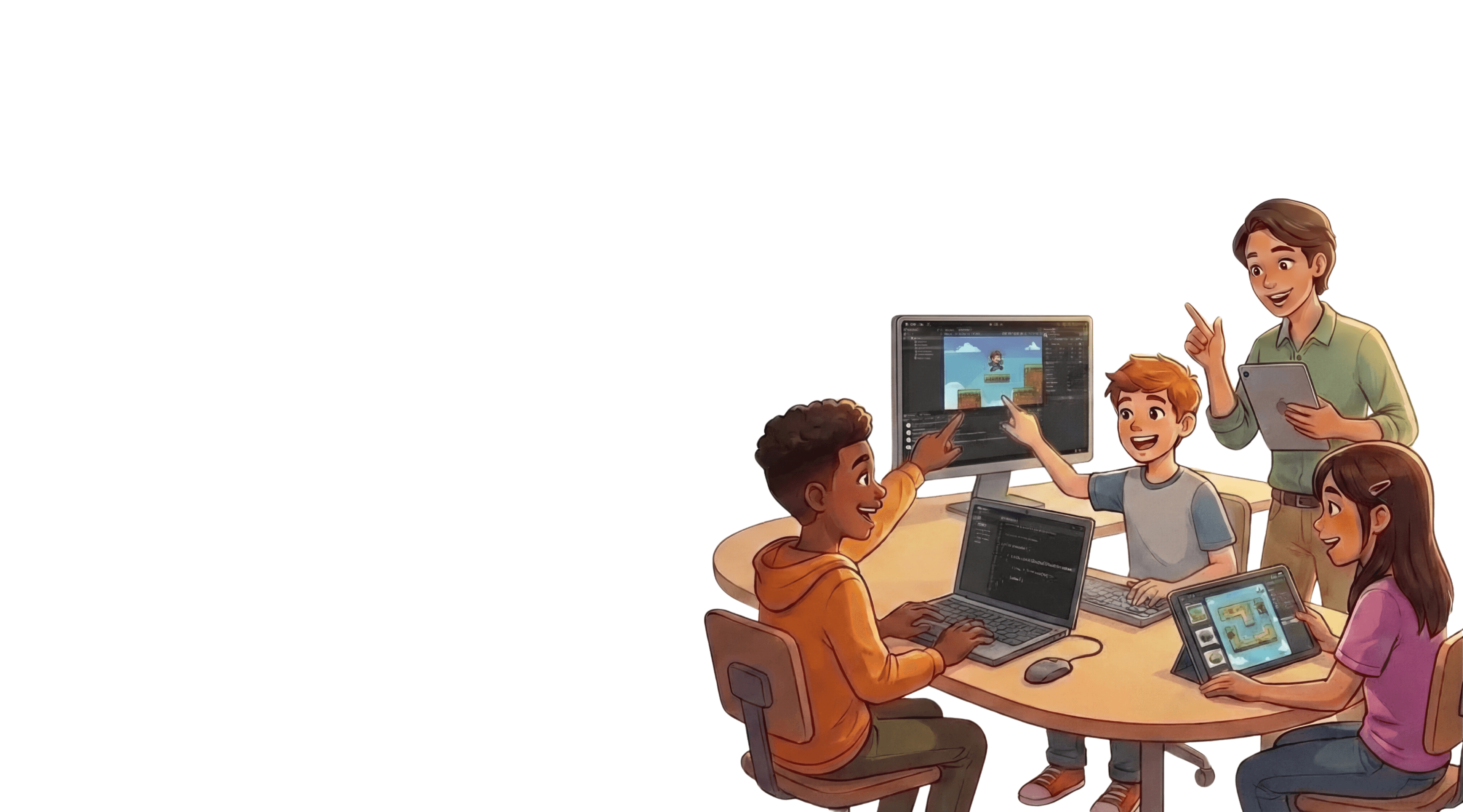
Gamecoder is structured for school rollout: students learn through planning, coding, testing, and revision while teachers stay visible to the work and publishing begins from a private-first model.
Rollout Path
This is not a jump from idea to open publishing. The better path is staged: pilot, classroom use, supervised sharing, then broader policy decisions once the school is comfortable.
01
Start with a single teacher, a known group of students, and private project creation while staff learns the workflow.
02
Students move from prompt to playable game in the browser while teachers review progress and keep the room visible.
03
Publishing becomes a supervised step with sign-in requirements and oversight still attached to the work.
04
Any broader visibility decision happens after the pilot, as a school choice, rather than as a product default.
Outcome
The product stays grounded in making, not passive prompting, so AI becomes part of a real classroom workflow.
Prompting connected to planning and revision
Real code edits and game logic changes in the browser
Fast testing loops without local setup
A clearer path from idea to playable project
Outcome
The operating model is built to keep visibility, moderation, and rollout decisions legible to adults.
Private-first starting point for student work
Teacher and admin oversight around publishing
Signed-in sharing instead of open-by-default exposure
Deliberate policy decisions before broader visibility
Role View
The page should work for the principal who approves the pilot, the teacher who runs it, the student who learns through it, and the IT lead who needs the operating model to stay legible.
Sees the operating model quickly: private start, supervised sharing, and a clear pilot path before expansion.
Runs the classroom experience, monitors student projects, and stays in the loop when work moves toward sharing.
Builds a real game, learns with iteration, and shares work inside the boundaries the school has chosen.
Gets a product story that is easier to vet because visibility and rollout assumptions are explicit.
Policy Matrix
Instead of hiding trust behind generic feature cards, spell out the default stance: who sees work, who guides sharing, how AI is used, and what remains a school-level choice.
School
Projects begin private and signed-in sharing stays the present default.
Teacher
Teachers review progress and understand when work is moving toward publication.
Student
Students can build and revise without starting from public exposure.
School
The school can define how publishing should be used before any broader rollout.
Teacher
Teachers remain part of the supervised publishing path.
Student
Sharing happens inside the classroom model rather than as a one-click public default.
School
The product is framed around literacy through making, not passive generation.
Teacher
Teachers can keep AI use tied to planning, coding, and revision.
Student
Students still build, test, debug, and iterate on the final game.
School
Expansion decisions are made by policy once the school is ready.
Teacher
The classroom workflow can be validated before widening access.
Student
Students get a stable experience while adults decide what opens next.
Next Step
The strongest first move is usually narrow: one teacher, one bounded rollout, clear publishing expectations, and a trust model the school can explain before it expands.